- The Ultimate Platform for Streamer Betting and Esports Duels
Valorant Ranks: How the Ranked System Works and How to Climb

Valorant ranks show your competitive level in Riot’s tactical shooter, from Iron at the bottom to Radiant at the top. The system is built around ranked tiers, Rank Rating, hidden matchmaking rating, match wins, individual performance, and consistency over time. If you want to understand where you stand, the visible badge is only the start. Your real progress comes from winning rounds, improving decisions, and becoming more reliable across many matches.
Valorant ranked feels different from casual play because every round has weight. One bad peek, one weak buy, or one poor rotation can change the scoreline. That is why climbing is not only about aim. Aim helps, but the strongest players also understand economy, utility, spacing, trading, map control, and team timing.
Article content:
- All Valorant Ranks in Order
- How the Valorant Rank System Works
- Valorant Ranking System: What Actually Matters
- What Each Valorant Rank Usually Means
- How to Climb Valorant Ranked
- Why Players Get Stuck
- Best Mindset for Ranking Up
- Final Thoughts
- FAQ
All Valorant Ranks in Order
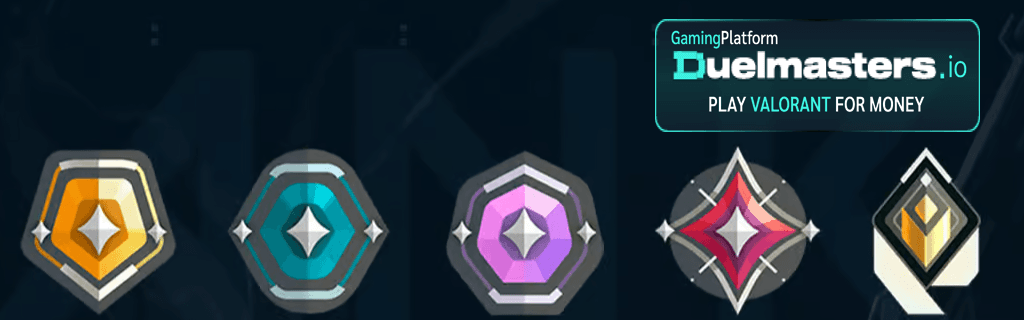
All Valorant ranks move from beginner levels to elite competitive play. The full ladder is:
- Iron
- Bronze
- Silver
- Gold
- Platinum
- Diamond
- Ascendant
- Immortal
- Radiant
Most ranks in Valorant have three tiers. For example, Silver 1 is lower than Silver 2, and Silver 3 is the final step before Gold 1. Radiant is different because it is the highest rank and is reserved for the best players in each region.
A clean way to read the ladder is simple: Iron to Silver is the learning stage, Gold to Platinum is the average-to-solid stage, Diamond to Ascendant is advanced play, and Immortal to Radiant is elite competition.
Duelmasters – The Ultimate Platform for Streamer Betting and Esports Duels
How the Valorant Rank System Works
The Valorant rank system uses Rank Rating, usually called RR, to move players up or down. After a ranked match, you gain RR if you win and lose RR if you lose. In most ranks, reaching 100 RR pushes you into the next tier or rank. Losing too much RR can drop you down.
But RR is not the whole picture. Valorant also uses hidden MMR, which is Riot’s internal estimate of your skill. This hidden rating affects who you play against and how much RR you gain or lose. If the system thinks you are stronger than your visible rank, you may gain more RR for wins. If it thinks you are over-ranked, losses may hurt more.
That is why two players in the same Valorant rank can receive different RR changes after similar matches. The game is not only looking at the final scoreboard. It is also judging your performance against its expectation of your skill level.
Duelmasters – Watch Streamers, Predict Results, and Win Real Rewards Instantly
Valorant Ranking System: What Actually Matters
The Valorant ranking system rewards winning first. Individual performance can matter, especially in lower and middle ranks, but round wins are still the foundation. A player who drops 25 kills but loses repeatedly will not climb consistently. A player who wins rounds, trades teammates, uses utility well, and plays smart post-plants will usually move up over time.
The game does not rank Valorant players by kills alone. It cares about whether your actions help your team win.
Important factors include:
- match result;
- round difference;
- individual impact;
- hidden MMR;
- consistency;
- opponent strength;
- performance relative to expectation.
This is why baiting for kills is a bad long-term strategy. It may improve your scoreboard, but it often loses rounds. Valorant rewards players who create winning situations, not just highlight clips.
Duelmasters – Real-Money Esports Betting on Streamers
What Each Valorant Rank Usually Means
Iron
Iron players are usually learning the basics: movement, crosshair placement, recoil, abilities, and map layout. The biggest improvements here come from stopping panic sprays, learning one or two agents, and playing slower.
Bronze
Bronze players understand the game better but often struggle with consistency. Aim may be unstable, utility is often wasted, and team coordination is limited. Climbing from Bronze usually requires cleaner crosshair placement and fewer unnecessary fights.
Silver
Silver is one of the most common ranks. Players know the basics but still make repeated mistakes with positioning, economy, and rotations. If you are Silver, learning when not to peek can be more valuable than aim training.
Gold
Gold players usually have decent mechanics and some tactical awareness. The problem is often decision-making. Many Gold players can win duels but lose rounds because they overextend, ignore spike timing, or fail to trade.
Platinum
Platinum is where games become more structured. Players punish mistakes faster and understand agent roles better. To climb from Platinum, you need stronger utility use, better communication, and more disciplined fights.
Diamond
Diamond players are mechanically strong and usually understand the core ranked structure. Mistakes are punished quickly. Winning here requires better team play, strong map awareness, and fewer ego peeks.
Ascendant
Ascendant is a serious rank. Players here are close to high elo and often have strong aim, better utility timing, and sharper game sense. Small mistakes in positioning or economy can decide the match.
Immortal
Immortal is elite. Players are fast, confident, and usually understand advanced concepts like defaulting, pressure, space control, and coordinated retakes. Solo plays still happen, but weak fundamentals are punished hard.
Radiant
Radiant is the top of Valorant ranked. These players are among the best in their region. They combine aim, discipline, utility, communication, and deep game understanding. Radiant is not just a badge. It is proof of elite consistency.
How to Climb Valorant Ranked
Climbing Valorant ranked is not about changing everything at once. The fastest improvement usually comes from fixing the mistakes that happen every match.
Start with these priorities:
- Crosshair placement
- Keep your crosshair at head level before the duel starts. This reduces the amount of adjustment needed.
- Agent pool
- Play two or three agents seriously. Knowing your utility deeply is better than playing every agent poorly.
- Trading
- Stay close enough to teammates to trade kills. A 1-for-1 trade is often better than dying alone.
- Economy discipline
- Stop forcing bad buys. A coordinated save round can win the next full-buy round.
- Map control
- Do not give up space for free. Use utility to take or hold important areas.
- Post-plant decisions
- After the spike is planted, stop hunting unnecessary kills. Play time, crossfires, and utility.
- Tilt control
- Ranked is a long-term climb. One bad game should not destroy the next three.
Why Players Get Stuck
Most players stuck in one Valorant rank repeat the same mistakes without noticing. They blame teammates, smurfs, agents, or matchmaking, but their own habits stay unchanged.
Common problems include:
- peeking alone;
- reloading in unsafe spots;
- ignoring the minimap;
- using utility too late;
- forcing every round;
- chasing kills after spike plant;
- playing too many agents;
- not communicating enemy positions;
- tilting after pistol round.
The easiest way to improve is to review your deaths. Ask one question: did you die because of aim, positioning, timing, utility, or impatience? Patterns will appear quickly.
Best Mindset for Ranking Up
The best mindset is to stop treating ranked as a test of ego. Treat it as a feedback loop. Every match shows what you need to fix next.
If you are low rank, focus on mechanics and simple decisions. If you are mid rank, focus on consistency and team play. If you are high rank, focus on small edges: timing, utility layering, information control, and pressure management.
Valorant ranking is not random over the long term. A single match can feel unfair, but 100 matches usually reveal your real level. If you improve the right things, the badge eventually follows.
Final Thoughts
Valorant ranks are a clear way to measure competitive progress, but they are not only about aim. The full ladder runs from Iron to Radiant, with each rank representing a different level of skill, discipline, and understanding. The Valorant rank system rewards winning, consistency, and impact, while hidden MMR helps shape how fast you climb.
If your goal is to improve, do not obsess over one loss. Focus on better crosshair placement, smarter utility, stronger communication, cleaner economy, and fewer emotional decisions. That is how players move through the ranks in Valorant and turn ranked frustration into steady progress.
FAQ
What are Valorant ranks?
Valorant ranks are competitive tiers that show your skill level in ranked matchmaking. The ladder starts at Iron and ends at Radiant.
What are all Valorant ranks?
All Valorant ranks are Iron, Bronze, Silver, Gold, Platinum, Diamond, Ascendant, Immortal, and Radiant.
How does Valorant ranked work?
Valorant ranked uses Rank Rating and hidden MMR to move players up or down after matches. Wins usually increase RR, while losses reduce it.
What are the ranks in Valorant?
The ranks in Valorant are Iron, Bronze, Silver, Gold, Platinum, Diamond, Ascendant, Immortal, and Radiant, with most ranks split into three tiers.
What is a Valorant rank?
A Valorant rank is your visible competitive badge, such as Gold 2, Diamond 1, Immortal 3, or Radiant.
How does the Valorant rank system work?
The Valorant rank system combines match results, RR, hidden MMR, and performance to adjust your competitive placement.
Is Valorant ranking based only on kills?
No. Valorant ranking is based mainly on winning matches and rounds. Kills help, but utility, trading, economy, and objective play matter too.
How do you rank Valorant faster?
To climb faster, play a small agent pool, improve crosshair placement, trade teammates, manage economy, communicate clearly, and avoid tilt.